Stuck clearing interviews OR Stagnating at the same role OR Difficulty transitioning to a Leadership role?
Register here for the 2-hour masterclass!!
The AI Document Nobody Reads (But Everyone Should)
#AI-LITERACY
Anand Dwarakanath
6/13/20263 min read
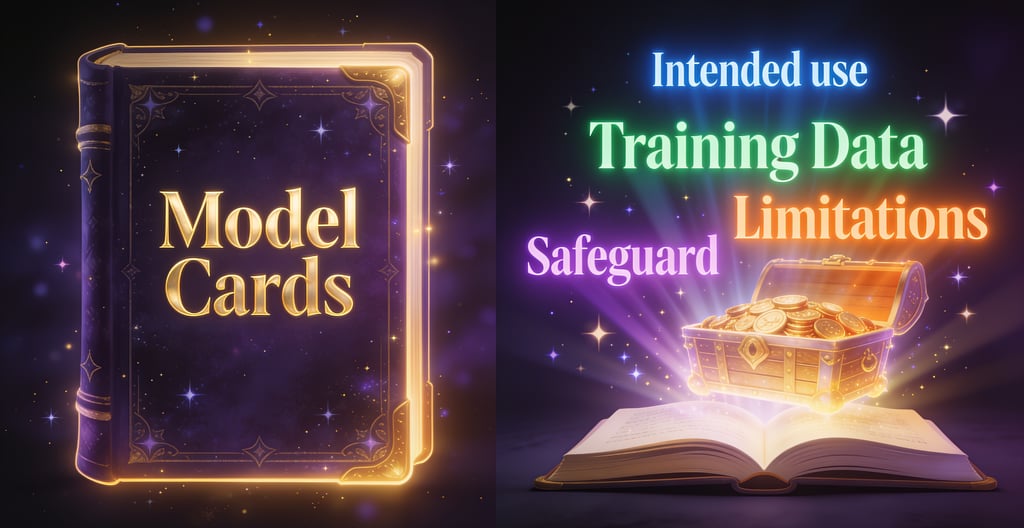
Model Cards Or System Cards: The One Document Every AI User Should Understand
Most people use AI tools like ChatGPT, Claude, or Gemini without ever asking a basic but important question: How do I know what this model is good at, where it can fail, and what risks come with using it?
That is where model cards or system cards come in.
They are not marketing brochures. They are not technical research papers written only for engineers. Think of them as the AI equivalent of a product label, safety sheet, and user guide rolled into one.
What is a model card or system card?
A model card is a document that explains what an AI model is, what it was designed for, on what data was it trained, how it was evaluated, and where it may not work well, what are the guardrails and known risks.
A good model or system card usually includes:
Purpose and intended use: What the AI is meant to do.
Limitations: Where it may fail, hallucinate, or produce wrong answers.
Training or evaluation summary: What kind of testing was done.
Safety and misuse risks: What harmful use cases were considered.
Performance notes: Where it performs well and where it does not.
Bias and fairness notes: Whether certain groups may be treated unfairly.
Privacy or security considerations: Whether the system may expose sensitive data, be manipulated, or be used unsafely.
Governance notes: Any policy, review, or accountability information.
Not every card is equally detailed, but the best ones help users understand both capability and risk.
Why is it needed?
Because AI can sound confident even when it is wrong.
A model card helps people avoid treating AI like magic. It sets realistic expectations. It tells users:
what the system was built for,
what it should not be used for,
what risks come with deployment,
and what safeguards are already in place.
This matters for everyone, from a student using an AI chatbot to an enterprise deploying AI in a customer-facing product.
How regular users can use it?
If you're using an AI tool at work, the model card tells you what it was designed for and what it wasn't.
Be careful while utilizing it for confidential/sensitive data like company proprietary data, legal documents, medical related questions, financial questions or documents etc., Before utilizing any AI tool or model look at their model cards.
How security teams can use it?
From a security standpoint, a model or system card is useful for both attackers and defenders. Not because it is a vulnerability report, but because it reveals how to think about the system.
From an attacker’s perspective
An attacker may look for:
weak spots in the model’s boundaries,
situations where the AI is likely to follow unsafe instructions,
places where prompt injection, data leakage, or social engineering might work,
and gaps between the model’s stated limits and its real behavior.
This is exactly why security teams should read the card carefully. If the card says the model struggles with certain tasks or can be manipulated in certain ways, that becomes a signal for threat modeling.
From a defender’s perspective
A defender should use the card to:
identify where the model should not be exposed,
decide what data must never be sent to it,
define red-team and abuse-testing scenarios,
and create monitoring rules for misuse, leakage, or policy violations.
In other words, the card helps security teams ask better questions:
What can go wrong? What should be blocked? What should be logged? What should be reviewed by a human?
How leadership should use it?
For leaders, this is not just a technical document. It is a risk and strategy document.
A good leadership team should use model/system cards to answer:
Is this AI use case aligned with business goals?
What risks are acceptable and which are not?
What data is being used, and is that appropriate?
Do we have the right controls before scaling?
Who owns the decision if the AI makes a harmful mistake?
This is where AI moves from “cool tool” to “managed capability.”
Leaders do not need to read every technical detail, but they should use the card to drive decisions on:
Adoption,
Vendor review
Compliance
Incident readiness &
Governance
If you'd rather see this explained, I've covered this on my YouTube channel — watch it below.
